
How it works
Cameras are installed on the portal and sill beams in positions that keep a perpendicular view of each container. Using PLC signals, the portal-beam cameras automatically capture the correct short-side image (door or rear), depending on whether the crane lifts a 20 ft or 40 ft container.
Meanwhile, the sill-beam cameras record the long side. These cameras automatically switch between internal sensors and lenses based on the active lane, covering distances from just a few meters up to roughly 32 meters.
Together, the system captures short-side and long-side images in two coordinated steps:
- Discharge: short sides first, then long sides
- Loading: long sides first, then short sides
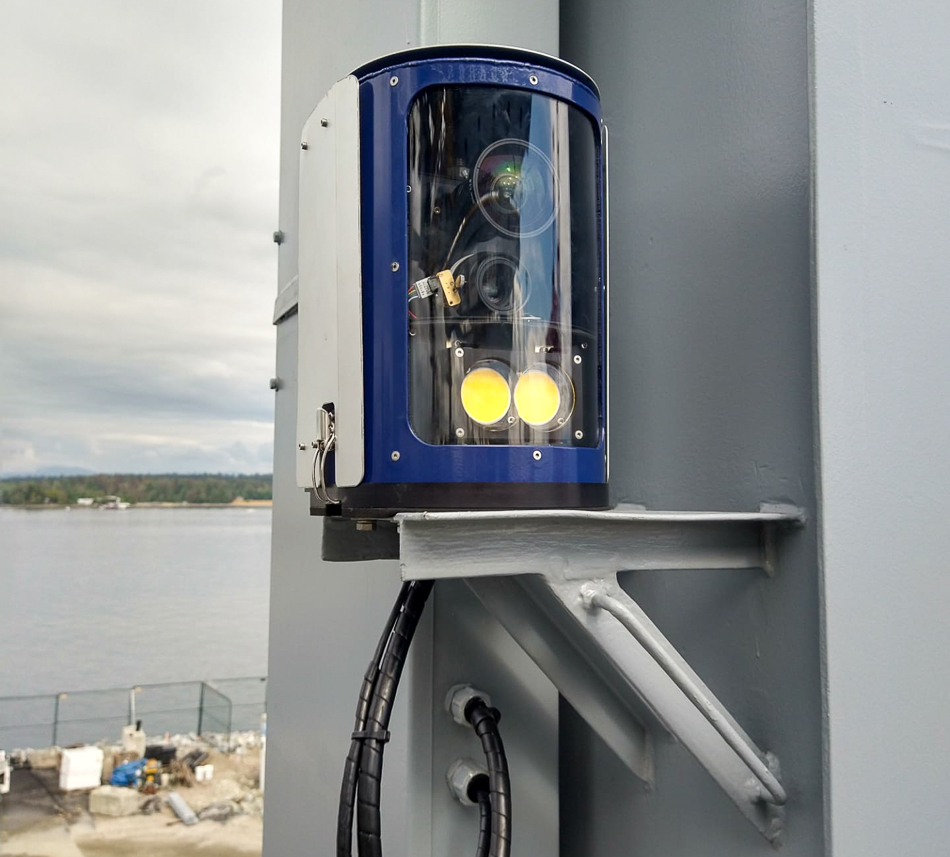
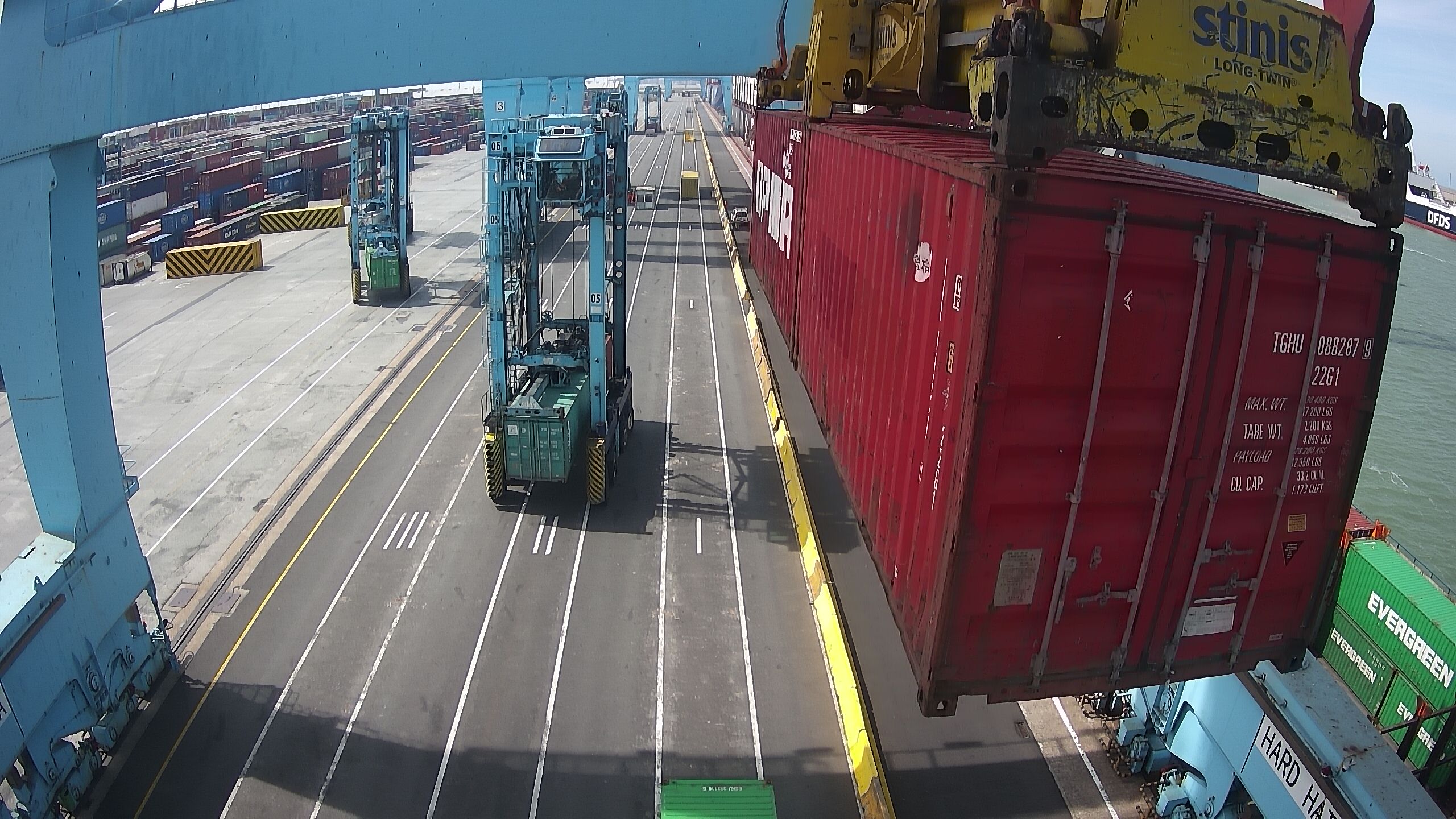
The required number of cameras varies (typically 10–24 or more), depending on:
- the number of traffic lanes under the crane
- whether roof cameras are needed to identify trucks
- whether ADI (Automatic Damage Inspection) is required
(360° high-resolution capture of all container sides)
All cameras perform edge-AI processing, executing OCR and OFR directly on the units themselves. In addition, several cameras use dual or triple sensors and lenses, which eliminates the need for zoom adjustments between 20 ft and 40 ft containers on the short side, or between different lanes on the long side.
During each pick or set-down:
- High-resolution global shutter images are captured automatically
- OCR/OFR software extracts container ID, ISO code, door direction, seal presence, DG labels and (optionally) damage-inspection frames
- Images and data are forwarded in real time to the TOS via the crane control system
Zero crane slow-down.
No special operator action required.
Unrestricted spreader motion.
Operational benefits
- Full crane OCR/OFR on every move, day and night
- Stable performance in wind, spray, backlight and glare
- Fewer exception jobs and manual corrections
- High-resolution condition images for claims and documentation
- Real-time synchronization with the TOS
This keeps vessel operations flowing and reduces cognitive load for crane operators and control room staff.
Technical characteristics
- 16-MP Sony global-shutter image sensors
- Edge-AI processing for low latency
- Supports single, twin, tandem and 20/40/45ft configurations
- Optional high-resolution image archiving for damage workflows
The system supports seaside moves only (no back-reach operation) and requires the spreader path to remain above the portal beam.
Maintenance and durability
Built for continuous use in maritime environments.
Optics, housings and illumination remain usually accessible from crane walkways.
Key components are modular and swappable to minimize downtime.
Whats the difference between a static camera system and a BoxCatcher?
When only two or three lanes need to be covered and the primary requirement is capturing the container number, a static camera OCR system can be a cost-efficient alternative.
The key difference between a static OCR system and a BoxCatcher lies in image quality and consistency. A BoxCatcher always captures a 360° images at a fixed distance, with a controlled angle and uniform lighting. Combined with high-resolution image sensors (12 MP) and a fully optimized sensor surface, this ensures sharp, repeatable images under all conditions.
With static camera systems, image quality varies significantly. Distances to the container—especially on the long sides—can range from as little as one meter up to 30 meters, which has a major impact on image clarity, particularly during night operations. In addition, the container doors or rear are not always centered on the image sensor due to diagonal container movements through the portal beam.
To avoid missing container corners or sides, static systems typically require wider lenses. This results in a smaller container area being captured on the sensor, reducing effective resolution. As a consequence, advanced use cases such as seal detection or IMDG label recognition become difficult or unreliable.
When more lanes need to be supported, the number of required static cameras increases rapidly. This leads to higher installation complexity and makes maintenance, calibration, and cleaning more demanding over time. A boxcatcher can be serviced via the portal beam, even during a shift. Cleaning of the 2 camera systems is automatically by use of a washing station.
To avoid mentioned problems some static system takes pictures when the container is still on the chassis, this is a very economical solution with quite clear pictures as container stands still. But the door/rear sides have to be taken with a very sharp angle reducing the application to only container number reading.
For terminals that require consistent high-quality imaging, advanced damage inspection, or scalable multi-lane coverage, a BoxCatcher solution provides superior performance and long-term operational efficiency.
