
How ROS works
The ROS backend server communicates with the rail OCR portals, THE BRIDGE, the TOS and the external systems used for exchanging the rail manifest. All train images are stored on the storage server.
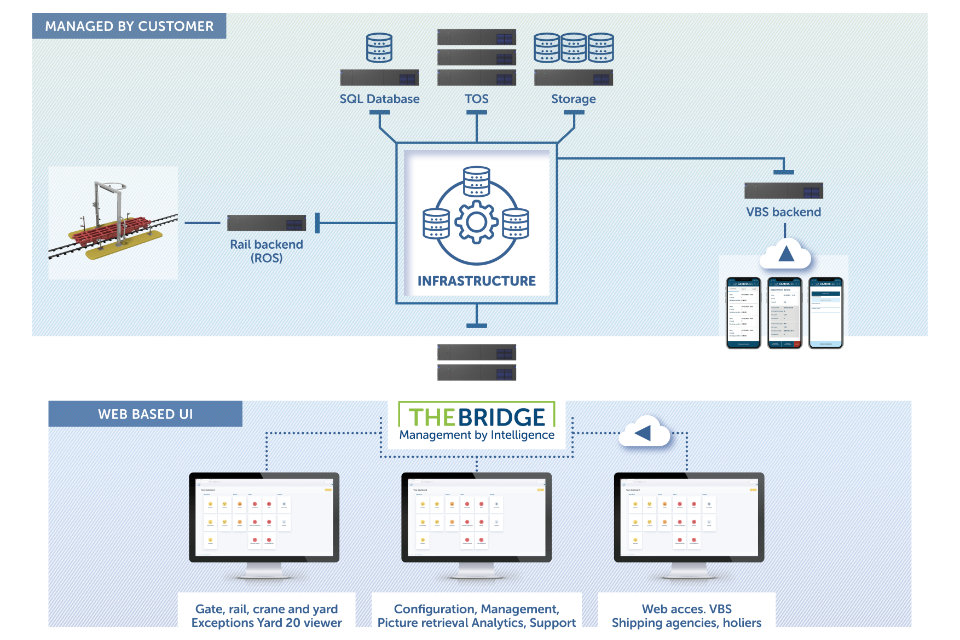
THE BRIDGE exception handling
Before OCR data is sent to the terminal Operating System (TOS), the operator verifies missing data and pictures in the operator tool. The completed data is sent to the TOS. Remote use for multiple sites is perfectly possible and AI-supported damage inspection is available in THE BRIDGE.
THE BRIDGE has two traingate operators. The TrainGate Track Operator for the US market and the TrainGate Passage Operator for the non-US market.
Frequently Asked Questions about Rail OCR System ROS
Rail processing metrics track read accuracy trends, RMG cycle time improvements, manifest exception rates, train turn performance, equipment utilization patterns, weather impact analysis, peak hour throughput capacity, and ROI calculations supporting continuous optimization, staffing justification, infrastructure planning, and performance benchmarking against industry standards.
Comprehensive rail ecosystem connectivity includes Railinc/UTG interfaces, AAR equipment registers, EDI interchange protocols, TOS bidirectional synchronization, RMG crane controllers, customs rail manifest systems, interline partner feeds, and terminal-specific protocols enabling ROS deployment within established North American, European, and Asia-Pacific rail operating environments.
Versatile recognition supports 20′, 40′, 45′, 53′ containers, reefers, out-of-gauge cargo, empty chassis, double-stack configurations, multi-platform rail cars, and trailer-on-flatcar combinations with specialized imaging profiles, dimensional analysis, equipment type classification, and workflow adaptation ensuring comprehensive coverage across diverse intermodal rail fleets.
Automated cross-checking against electronic train manifests identifies missing containers, positioning discrepancies, duplicate bookings, hazardous cargo mismatches, seal condition exceptions, and documentation inconsistencies generating prioritized exception workflows, carrier notifications, customs alerts, and supervisor escalations maintaining manifest integrity throughout rail processing operations.
Precise container location mapping feeds directly into RMG crane control systems providing exact pick coordinates, stacking sequence instructions, anti-collision zoning between gantry spans, load verification confirmation, real-time status updates, and performance feedback loops optimizing rail unloading/loading cycles while protecting multimillion-dollar rail handling infrastructure.
Industry-leading 99.7% first-pass read accuracy validated across diverse rail car types, container positions, weather conditions, lighting variations, and international code formats through AI-powered character recognition, context-aware error correction, cross-verification against electronic manifests, and continuous learning from operational data improving performance over deployment lifetime.
Multi-perspective rail car imaging arrays positioned along track corridors capture container codes from overhead, side, and angled positions using high-resolution industrial cameras with adaptive LED illumination, motion compensation stabilization, sequential frame analysis, and environmental compensation ensuring reliable identification regardless of train speed or positioning.
Rail OCR System (ROS) automatically identifies containers on rail cars using advanced imaging and recognition technology eliminating manual verification processes while coordinating RMG crane operations, validating train manifests, generating precise work instructions, and integrating rail data with terminal operating systems for seamless intermodal container processing.
